
 Simrita Mishra
As Kubernetes‘ environments continue to scale, ensuring application resiliency and reliability becomes increasingly critical. In distributed microservices architectures, failures such as increased latency, service timeouts, and unexpected errors are inevitable and can significantly impact user experience and system stability.
Istio Ambient Mesh simplifies service mesh adoption by removing sidecars and introducing Waypoint Proxies for Layer 7 traffic control. This makes it easier to apply advanced traffic management and resiliency patterns in a scalable and efficient manner.
In this blog, we will focus specifically on delay and abort fault injection in Istio Ambient Mesh, exploring how these mechanisms work, their architecture, and how to implement them to simulate real-world failures and validate system behaviour.
Video on Delay and Abort Fault Injection in Istio Ambient Mesh
In case you want to refer to the video, then here it
Introduction to Fault Injection
Fault injection is a technique used to intentionally introduce failures into a system to observe its behavior and ensure resilience.
In Istio Service Mesh, fault injection is implemented through VirtualService configurations, allowing you to simulate:
- Latency (delays)
- Failures (HTTP errors)
This helps validate:
- Retry mechanisms
- Timeout configurations
- Circuit breakers
- Overall system resilience
Now let’s see the purpose behind it.
Purpose of Fault Injection
The main goal is chaos engineering deliberately injecting faults to verify system resilience, such as circuit breakers, retries, timeouts, outlier detection, and failover.
In Istio Ambient Mesh, faults are applied via waypoints between services, enabling tests for latency impact, autoscaling triggers, and error recovery without sidecar proxies.
Analogy: One can compare fault and delay injection with vaccines for a better understanding. As we know, the main purpose of any vaccine is to provide resiliency/immunity against any specific disease.
Next, we shall discuss the various types of Fault injection.
Types of Fault Injection
Istio supports two primary types configurable in Fault:
- Delay
- Abort
Delay Fault Injection
- Introduces artificial latency before forwarding requests to the service.
- Fixed or exponential delays (e.g., 4s fixed Delay) on a percentage of traffic (e.g., 100%)
Abort Fault Injection
- Forces requests to fail by returning HTTP error responses.
- Abort: HTTP status aborts (e.g., HTTP Status: 503) on specified traffic portions.
No additional types beyond these are standard, though they integrate with retries and outlier detection.
Next, we shall go through the architecture of both.
Architecture
Delay Injection Architecture
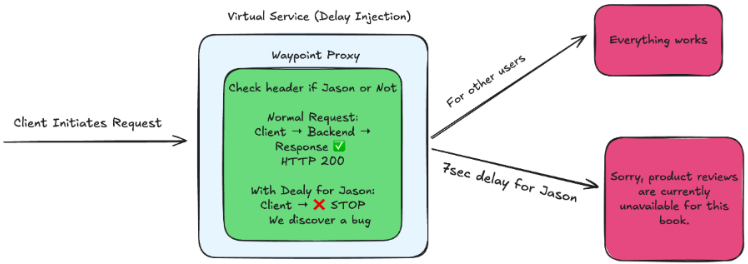
FIG A: Delay Injection Architecture
Delay fault injection test is used to simulate real-world failures in a service mesh (like Istio). The goal is to test how your app behaves when things slow down or break.
Let’s break it down step by step
- Client sends a request A user (client) makes a normal request to your application, like loading product reviews for a book.
- Request hits the Virtual Service The request enters a Virtual Service which has delay injection configured. Think of it as a traffic cop with special rules.
- Waypoint Proxy checks the header The proxy inspects the request header to answer one question: “Is this request from Jason?”
- Not Jason? No problem the request flows normally:Client → Backend → Response with HTTP 200. Everything works fine for all other users.
- Is Jason? Inject a 7-second delay For Jason specifically, the proxy artificially holds the request for 7 seconds before letting it through.
- The bug is discovered Because of that 7-second delay, the app times out and Jason sees: “Sorry, product reviews are currently unavailable for this book.”
This reveals that the app has no proper timeout handling, which is the bug being uncovered.
The whole point? Fault injection lets you intentionally break things for one specific user (Jason) without affecting anyone else, so you can safely find and fix bugs in a real-like environment.
Abort Injection Architecture
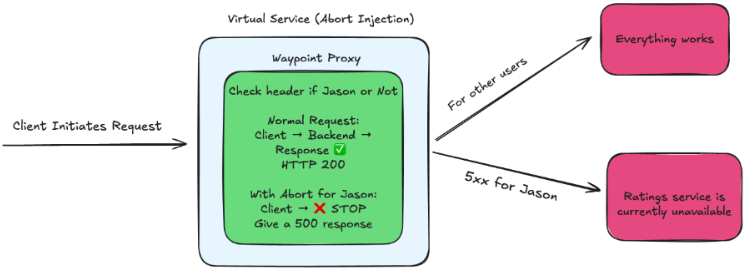
FIG B: Abort Injection Architecture
This is an abort fault injection test. Instead of slowing down a request like delay injection, this one immediately kills the request and returns an error, to test how your app handles failures.
Let’s break it down step by step
- Client sends a request A user makes a request to the application, like loading ratings for a book.
- Request hits the Virtual Service The request enters the Virtual Service which has abort injection configured. Same traffic cop, but with a harsher rule this time.
- Waypoint Proxy checks the header The proxy again asks: “Is this request from Jason?”
- Not Jason? All good Request flows normally:Client → Backend → Response with HTTP 200. Every other user gets their ratings without any issue.
- Is Jason? Abort immediately the proxy doesn’t even forward the request to the backend. It stops it right there and instantly sends back an HTTP 500 error (a 5xx response).
- Jason sees the failure message Because the request was aborted with a 500, Jason sees: “Ratings service is currently unavailable”
How is this different from Delay Injection?
In delay injection, the request was slowed down and eventually timed out. Here, the request is instantly rejected, no waiting, just an immediate hard failure. This tests whether your app can gracefully handle sudden service crashes, not just slowness.
Next let’s move to the prerequisites for the demo.
Demo prerequisites
For this demo, we are using:
- AWS EKS cluster
- Kubernetes version 1.34
- Istio with Ambient Mesh enabled
The goal is to set up an environment where we can:
- Deploy a sample application (Bookinfo)
- Enable Ambient Mesh data plane
- Configure a Waypoint Proxy for Layer 7 traffic control
- Apply fault injection policies
Demo
In this section, we demonstrate both delay and abort fault injection inside Istio Ambient Mesh.
Deploy Sample Application
Deploy a simple bookinfo service in your cluster.
Apply Fault Injection using Virtual Service
Fault injection is configured using Istio’s Virtual Service.
Delay Fault Injection Example
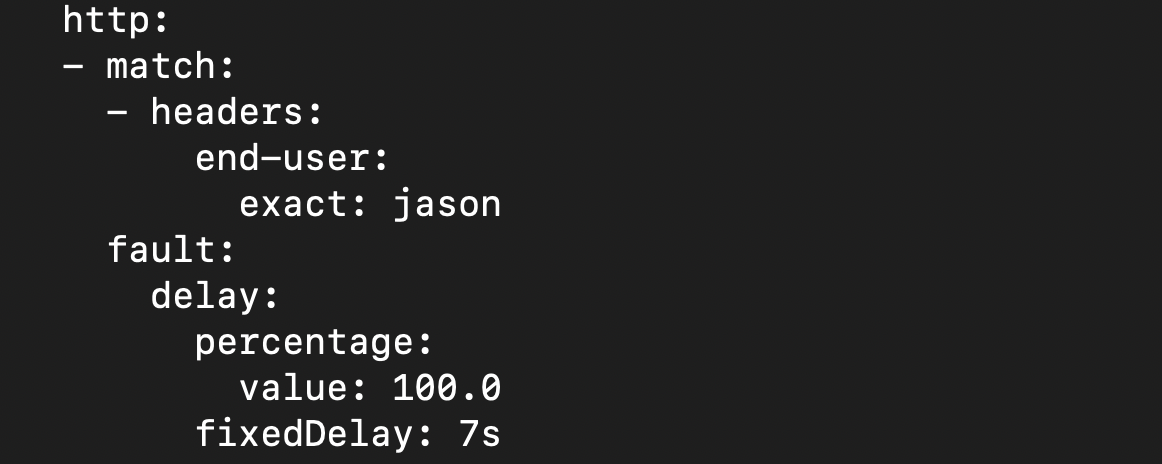
What this does:
- Delays of incoming requests from Jason by 7 seconds
Abort Fault Injection Example
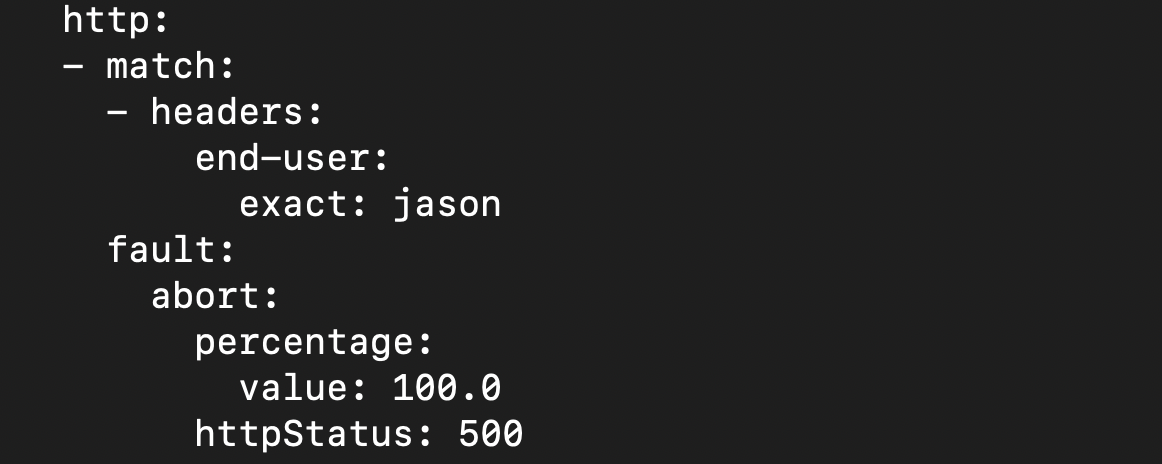
What this does:
- Returns HTTP 503 for requests send by Jason
Final Thoughts
Fault injection in Istio Ambient Mesh is a powerful capability for testing application resilience in Kubernetes environments. By using delay fault injection, teams can simulate latency and validate timeout handling. With abort fault injection, they can simulate failures and ensure systems respond gracefully under error conditions.
Since all enforcement happens at the Waypoint (Envoy) proxy layer, applications remain unchanged while still benefiting advanced traffic control and testing capabilities.
For modern microservices architectures, fault injection is not just a testing tool; it is a critical practice for building resilient, fault-tolerant, and production-ready systems.
IMESH provides enterprise-grade Istio Ambient Mesh support, Envoy Gateway expertise, and production-ready Kubernetes guidance to help teams deploy, scale, and optimize service mesh environments with confidence.
For Ambient Mesh support, reach out to our experts.