 Simrita Mishra
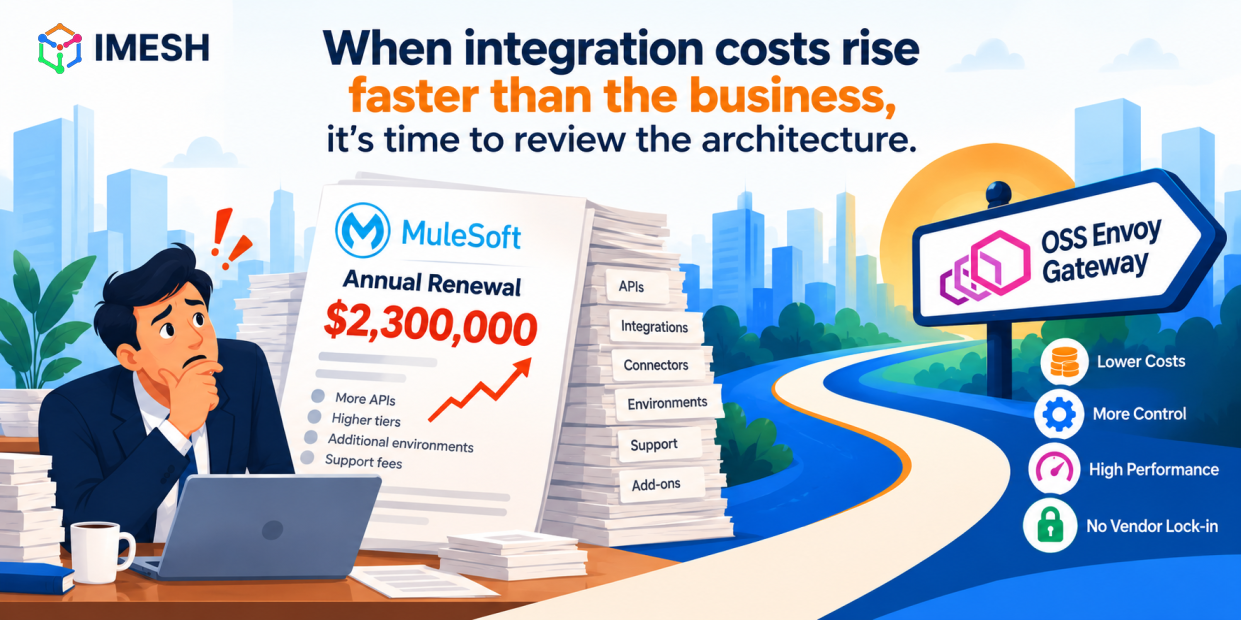
The platform engineering team had a familiar problem. Their APIs were working, integrations were running, and the business was growing. But every renewal brought another uncomfortable conversation with finance.
The MuleSoft bill kept climbing.
New integrations meant more complexity. Expanding usage increased costs. And the team began asking a question that many enterprise engineering leaders eventually face:
Are we paying for an integration platform when what we really need is efficient, high-performance API traffic management?
That question started a broader architecture review.
One alternative stood out: open-source Envoy Gateway, built on Envoy Proxy and designed to manage API traffic in Kubernetes-native environments.
For the right workloads, moving API gateway responsibilities to OSS Envoy Gateway can reduce licensing expenditure, improve flexibility, and give platform teams greater control over their infrastructure.
But there is an important distinction: MuleSoft is an integration platform, while Envoy Gateway is an API gateway. They are not direct, feature-for-feature replacements.
The opportunity lies in identifying which responsibilities can move to Envoy Gateway—and which integration capabilities need to remain or be redesigned.
Why Are Enterprises Rethinking MuleSoft?
The hidden cost of integration
MuleSoft can provide valuable capabilities for API-led connectivity, application integration, and enterprise workflows. However, its licensing model, usage requirements, implementation complexity, and operational overhead may become significant as organizations scale.
The real question isn’t whether MuleSoft is good or bad. It’s whether every workload still needs the same platform.
Some API traffic management requirements may be handled more economically by an open-source gateway.
What changes with OSS Envoy Gateway?
Envoy Gateway provides a Kubernetes-native approach to managing and routing API traffic, built on the high-performance Envoy Proxy.
It offers an open-source foundation without proprietary gateway licensing fees, although infrastructure, engineering, support, and operational costs still apply.
For organizations with suitable workloads, this can create an opportunity to reduce gateway-related costs without compromising performance or control.
Where IMESH fits in
IMESH helps enterprises evaluate, architect, migrate, and operate Envoy Gateway deployments, including production troubleshooting and enterprise support.
The goal is to identify where open-source infrastructure makes business sense—not to replace every existing integration capability indiscriminately.
Understand What You Are Migrating
Before planning a migration, separate MuleSoft’s capabilities into distinct categories.
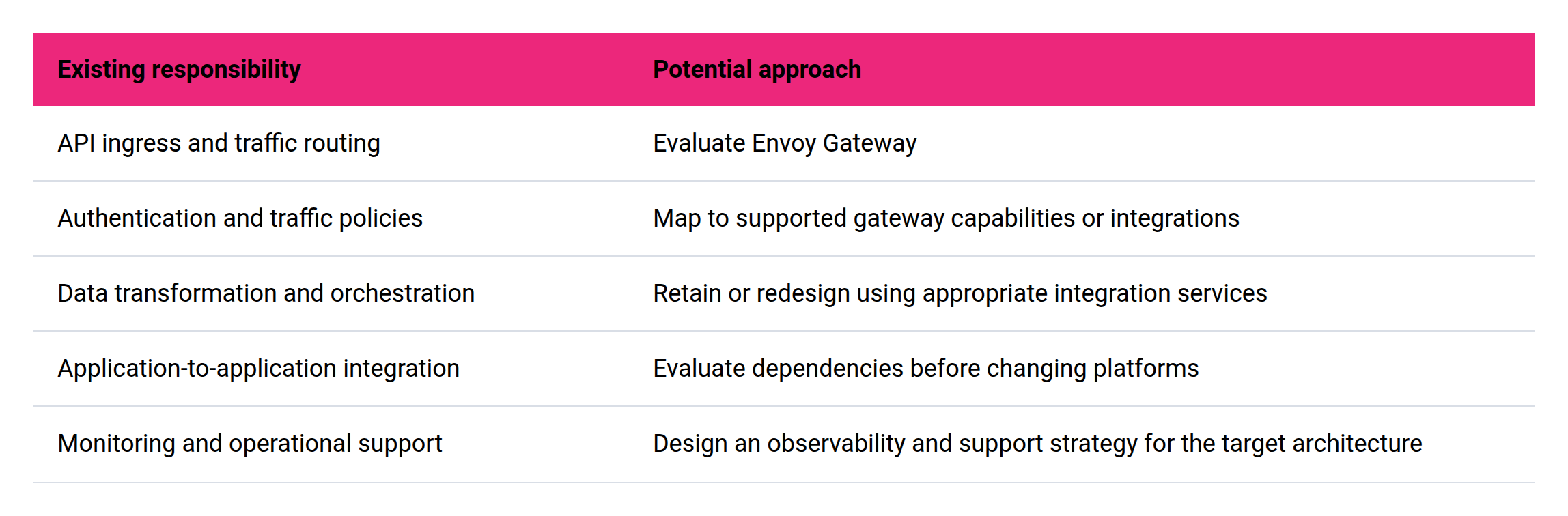
The distinction matters because replacing an API gateway is generally more straightforward than replacing complex integrations, data transformations, and business workflows.
The objective is selective modernization – not a risky, all-at-once platform replacement.
The Top 5 Considerations Before Migrating
1. Cost and Total Cost of Ownership
Start with the numbers. Compare current licensing and operating costs against the full cost of the proposed architecture.
Include infrastructure, migration engineering, ongoing maintenance, integrations, staffing, and enterprise support.
A credible business case should calculate savings over multiple years and distinguish between licensing reductions, one-time migration expenses, and recurring operational costs.
2. API Compatibility and Integration Dependencies
Inventory APIs, policies, connectors, transformations, authentication flows, and dependencies.
Identify which components can move to Envoy Gateway, which need adaptation, and which must remain on an integration platform.
Test representative workloads before committing to a production migration.
3. Architecture and Performance
Evaluate whether Envoy Gateway fits your target environment and traffic patterns.
Benchmark latency, throughput, resource consumption, availability, and scaling behaviour. Design for observability, resilience, and controlled traffic transitions.
The goal is not merely to reduce costs, but to maintain or improve the quality of service.
4. Security and Governance
Security cannot become an afterthought during migration.
Review identity integration, authentication, authorization, TLS, rate limiting, secrets handling, audit requirements, and policy enforcement.
Map each existing control to a supported implementation, and validate it before moving production traffic.
5. Migration Strategy and Enterprise Support
A successful migration needs clear ownership, realistic milestones, rollback procedures, and operational readiness.
Start with a low-risk workload, validate the target architecture, and expand gradually.
For mission-critical environments, enterprise support can help teams resolve production issues, review architecture decisions, and manage lifecycle upgrades.
A Practical MuleSoft-to-Envoy Gateway Migration Roadmap
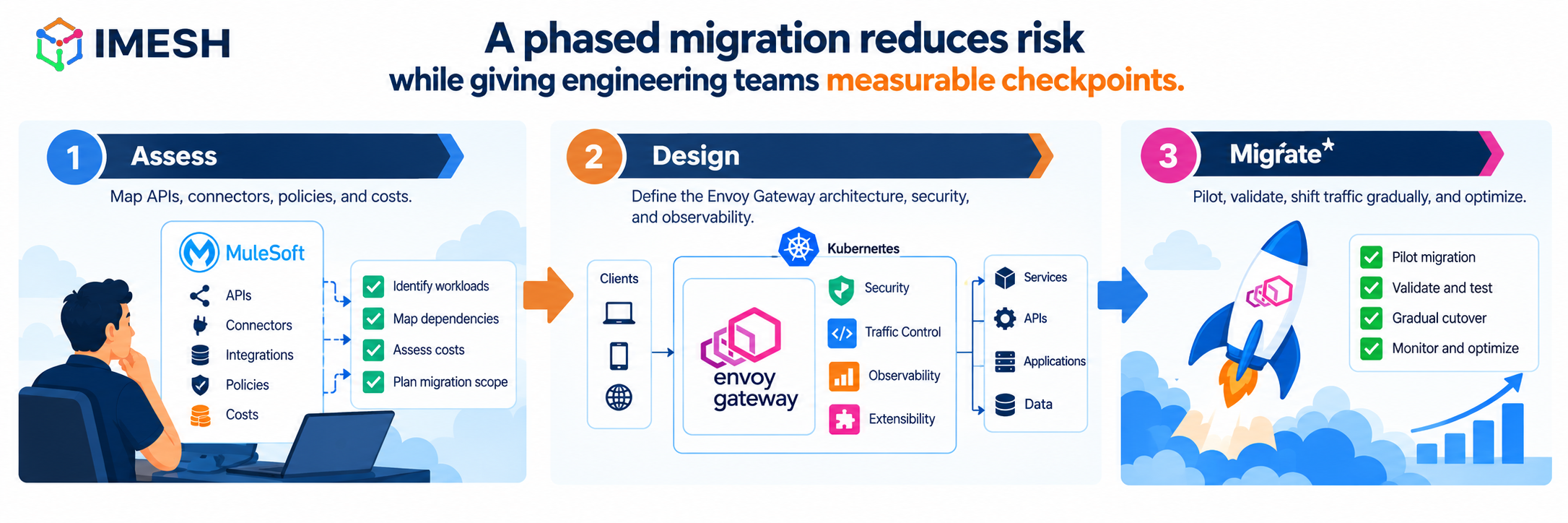
Step 1: Assess and map the current setup
Document existing APIs, traffic patterns, integration dependencies, licensing costs, security policies, and operational requirements.
Classify workloads according to migration complexity and business value.
Step 2: Design the target architecture
Define where Envoy Gateway will manage API traffic and which integration components will remain in place or be replaced with appropriate alternatives.
Establish security, observability, resilience, and operational requirements before implementation.
Step 3: Pilot, migrate, and optimize
Select a suitable workload for the initial migration. Test functional behaviour, performance, security, and failure recovery.
Shift traffic gradually, maintain rollback options, and measure results against the original business case.
Expand only when the pilot demonstrates that the architecture meets requirements.
Measure Success Beyond Licensing Savings
A migration is successful when it delivers sustainable business and engineering outcomes.
Track:
- Total cost of ownership before and after migration.
- API latency, throughput, and error rates.
- Availability and incident frequency.
- Migration effort and maintenance overhead.
- Security-policy coverage and audit readiness.
- Team productivity and operational flexibility.
These measurements help leadership determine whether the new architecture delivers the expected value—and where further optimization is possible.
Take Control of Your API Infrastructure
Rising integration costs don’t automatically mean you need another expensive platform. They mean it’s time to rethink which capabilities your business actually needs and what you’re paying to operate them.
OSS Envoy Gateway offers enterprises an opportunity to modernize API traffic management, eliminate proprietary gateway licensing fees, and gain greater architectural flexibility. The key is to identify the right workloads, validate the target architecture, and migrate in phases without disrupting critical business operations.
Don’t migrate everything blindly. Build the business case, measure the opportunity, and move with a clear strategy.
To get started, explore the Migration Guide for practical guidance on evaluating and planning your migration.
Need expert guidance for your enterprise environment? Visit IMESH Envoy Gateway Enterprise Support to discuss architecture, migration planning, production readiness, and potential cost savings.
Your next API gateway decision should be driven by engineering value – not just another renewal invoice.