 Simrita Mishra
It started with a simple question in a leadership meeting: “Why are we spending so much on our API gateway?”
The platform engineering team had a reliable API infrastructure built on Kong. But as traffic grew, licensing costs increased, customization became expensive, and even small feature requests started requiring significant investment.
For engineering leaders, this is more than a budget problem. It is a question of scalability, flexibility, and long-term control.
Open-source Envoy Gateway (OSS EG) offers another path: a modern, high-performance API gateway built on Envoy Proxy, without traditional enterprise gateway licensing fees.
But moving from Kong to Envoy Gateway requires more than replacing one technology with another. Here are five considerations engineering leaders should evaluate before making the switch.
1. Why move now?
Paying millions to Kong eh!!
Enterprise API gateway costs can become substantial as infrastructure scales. Licensing, support contracts, premium features, and customization can add up to a significant annual expense.
For organizations paying hundreds of thousands or millions of dollars annually, the question is simple: Are we paying for capabilities we could operate more cost-effectively ourselves?
OSS Envoy Gateway eliminates proprietary gateway licensing fees, allowing teams to redirect that budget toward engineering, security, and innovation.
Comparison table between Kong and OSS EG:
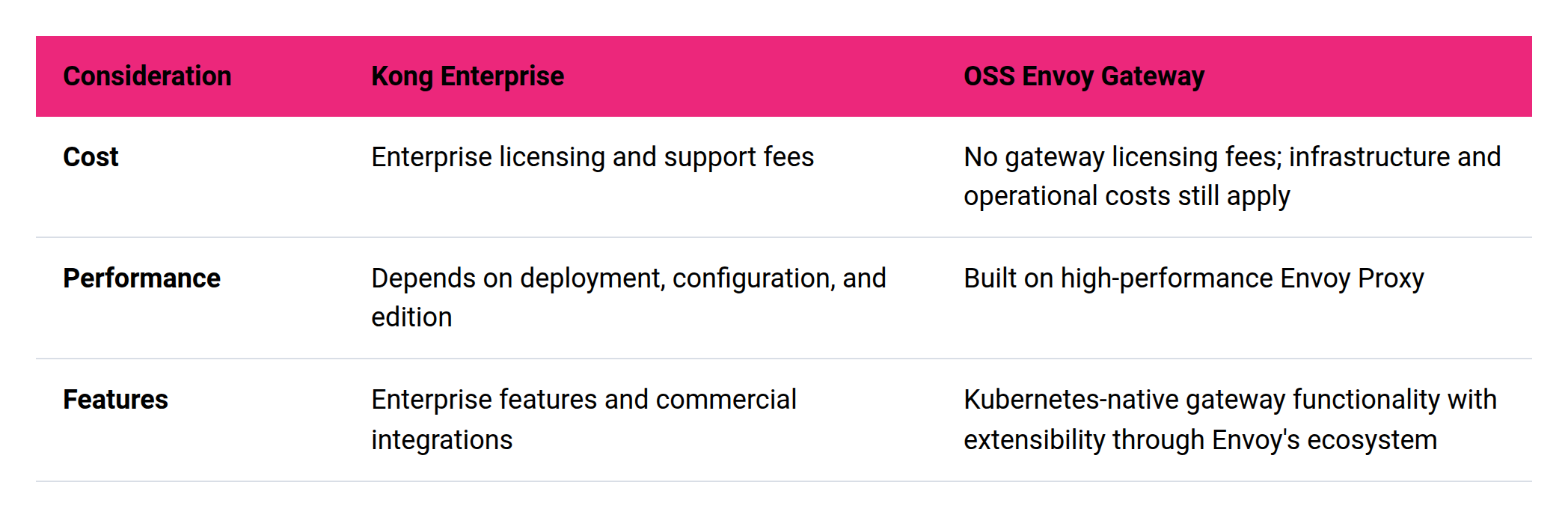
The right choice depends on workload requirements, existing configurations, required enterprise features, and the total cost of ownership not licensing alone.
GenAI helps to create features fast.
Need a custom integration or a new traffic policy? GenAI-assisted development can help engineering teams prototype configurations, generate code, write tests, and accelerate plugin development.
Combined with Envoy Gateway’s extensible architecture, this can reduce the time and cost associated with implementing specialized requirements. Production adoption still requires security reviews, testing, and performance validation.
OSS Envoy has fantastic support from IMESH: We have helped Fortune 500 companies to move from Kong to EG and save more than $1M USD
Open source does not have to mean going it alone.
IMESH provides enterprise-grade support for Envoy Gateway, helping organizations plan migrations, troubleshoot production issues, implement custom requirements, and operate their infrastructure with confidence.
IMESH has helped Fortune 500 companies migrate from Kong to Envoy Gateway, achieving savings exceeding $1 million USD in reported engagements.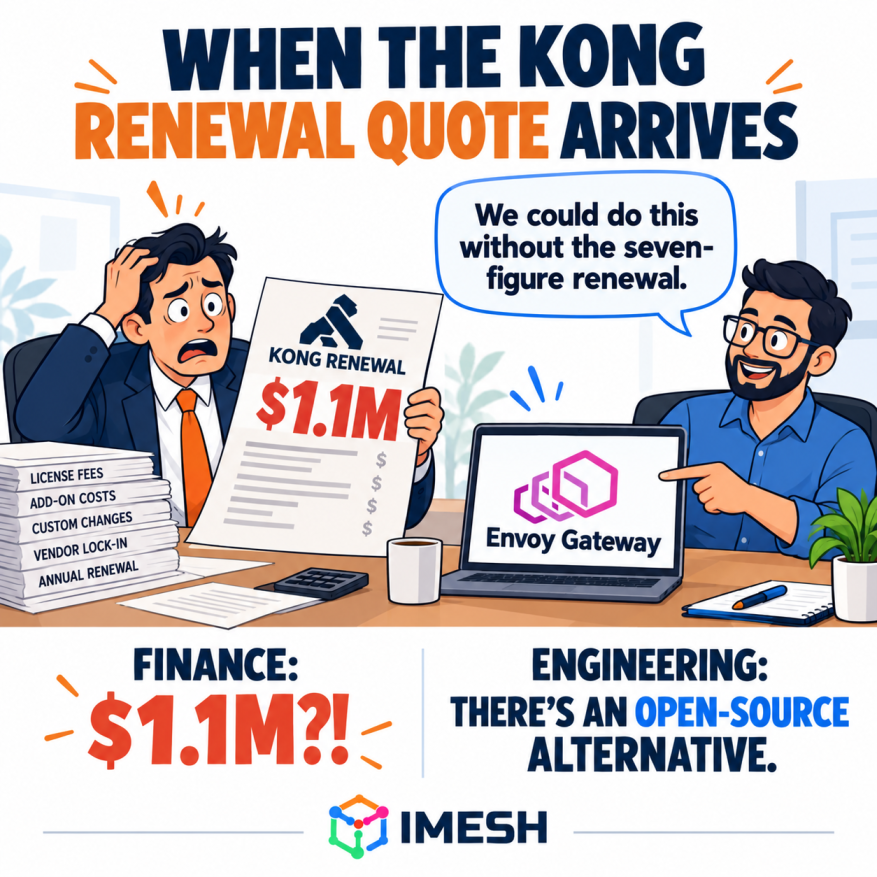
2. Compatibility Before Cost Savings
Migrating gateways is not simply a matter of changing configurations. Existing routes, authentication policies, rate limits, plugins, traffic transformations, and integrations may behave differently across platforms.
Before moving, engineering teams should inventory their current Kong setup and classify each capability:
- Ready to migrate: Standard routing and supported gateway functionality.
- Needs adaptation: Custom plugins, policies, or integrations that require redesign.
- Needs replacement: Proprietary capabilities that require an alternative implementation.
Run representative workloads through Envoy Gateway and validate functionality before shifting production traffic.
3. Security and Governance Must Travel With the Migration
A lower license bill is not a win if security controls become weaker.
Review how your existing gateway handles authentication, authorization, TLS, rate limiting, secrets, access policies, and audit requirements. Map each control to its Envoy Gateway equivalent or an explicitly selected integration.
Pay particular attention to enterprise requirements such as:
- Identity provider integration and authentication flows.
- Protection against abusive traffic and unauthorized access.
- Policy consistency across environments.
- Logging, observability, and compliance evidence.
Document gaps before cutover, and test failure scenarios not just successful requests.
4. Performance, Reliability, and Operational Readiness
A gateway migration should improve the economics of infrastructure without introducing unnecessary operational risk.
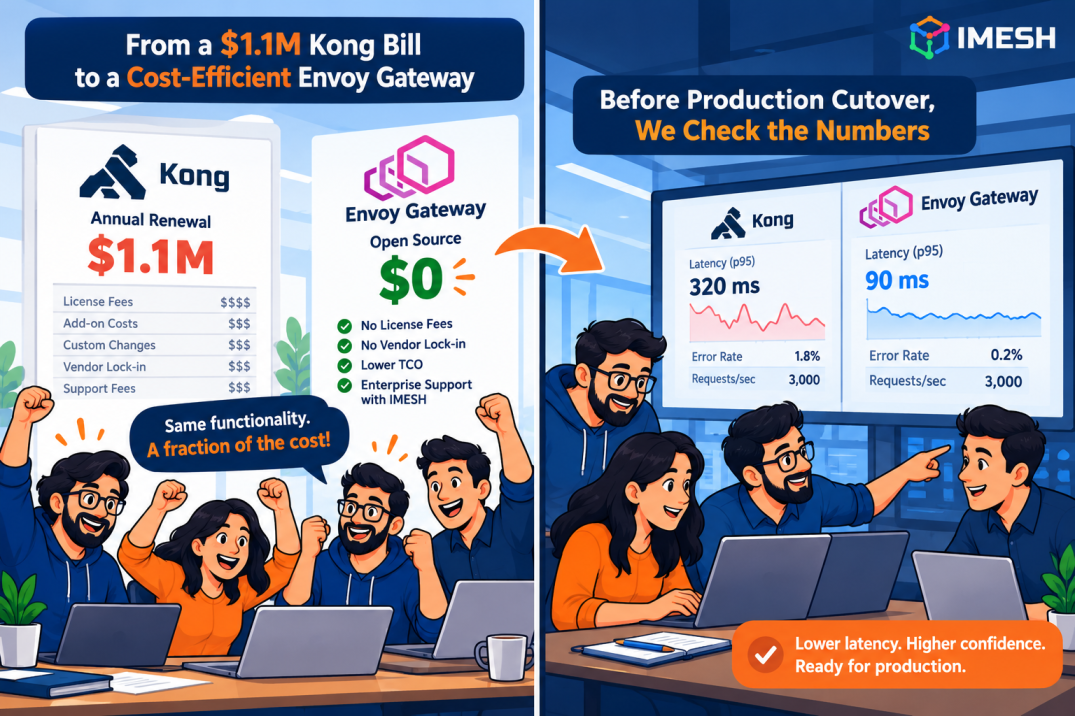
Benchmark both platforms against realistic workloads. Measure latency, throughput, resource consumption, error rates, and behaviour during traffic spikes.
Plan for gradual traffic shifting, health checks, rollback procedures, and clear ownership of production incidents. Also evaluate monitoring, tracing, access logs, upgrades, and incident response processes.
Open source provides flexibility, but teams still need the expertise and operational discipline to run it reliably.
5. Total Cost of Ownership and the Right Migration Partner
The final decision should be based on the total cost of ownership—not just the difference between two license invoices.
Consider infrastructure consumption, migration effort, plugin development, ongoing maintenance, staffing, support, training, and upgrade management.
A phased migration can help reduce risk:
- Assess: Inventory Kong routes, plugins, policies, dependencies, and costs.
- Prioritize: Select workloads with the clearest migration benefits.
- Pilot: Validate functionality, performance, and security in a controlled environment.
- Migrate: Shift traffic gradually, with monitoring and rollback plans.
- Optimize: Review costs and operational performance after cutover.
For organizations that need additional expertise, IMESH offers Envoy Gateway Enterprise Support, including production troubleshooting, architecture guidance, incident response, and lifecycle support.
The goal is not simply to replace a vendor. It is to build an API gateway strategy that gives engineering teams greater control over cost, capabilities, and future development.
Move Beyond the License Invoice
Kong may have served your organization well, but growing licensing costs and evolving infrastructure requirements make it worth reassessing your options.
OSS Envoy Gateway provides a compelling alternative for organizations seeking high performance, Kubernetes-native gateway capabilities, and freedom from proprietary gateway licensing fees.
The successful migration, however, depends on five things: cost justification, compatibility, security, operational readiness, and total cost of ownership.
With a structured migration plan and the right expertise, enterprises can modernize their API infrastructure without carrying unnecessary licensing costs into the future.
Ready to evaluate your Kong-to-Envoy Gateway migration?
Explore Kong to Envoy Migration to assess your current architecture, migration requirements, and potential savings.