 Simrita Mishra
AI adoption continues to accelerate across enterprises, but so do security concerns. Recent security reports have highlighted how exposed API keys, leaked credentials, and misconfigured secrets continue to be among the leading causes of cloud security incidents. As organizations integrate multiple AI providers into their applications, securely managing authentication credentials has become just as important as choosing the right language model.
Embedding API keys directly into application code or environment variables may seem convenient during development, but it quickly becomes a significant operational and security challenge in production.
Fortunately, Envoy AI Gateway addresses this problem with Upstream Authentication, allowing platform teams to securely manage credentials at the gateway layer while applications remain completely unaware of provider-specific authentication requirements.
In this blog, we’ll explore why credential management is challenging in AI environments, how Upstream Authentication works, the resources involved, supported authentication mechanisms, and the best practices for deploying it in production.
Video: Upstream Authentication in Envoy AI Gateway
In case you want the video, here it is
Why Managing AI Credentials is Becoming a Security Risk
Every AI provider requires authentication before processing requests.
Whether you’re using OpenAI, AWS Bedrock, Azure OpenAI, Anthropic, or Google Vertex AI, applications need credentials to communicate with these services.
Unfortunately, many organizations still manage these credentials in ways that introduce unnecessary security risks.
Some common examples include:
- API keys stored in environment variables across multiple services
- Credentials shared through Slack, email, or documentation
- Secrets accidentally committed to Git repositories
- Every development team managing its own provider credentials
As AI adoption grows, these practices create several challenges:
- Increased risk of credential leaks
- Difficult key rotation across multiple services
- Limited visibility into credential usage
- Inconsistent security practices between teams
- Greater operational overhead for platform engineers
A single compromised API key can potentially provide unrestricted access to an organization’s AI provider account.
Instead of allowing every application to manage secrets independently, organizations increasingly prefer centralizing authentication at the gateway.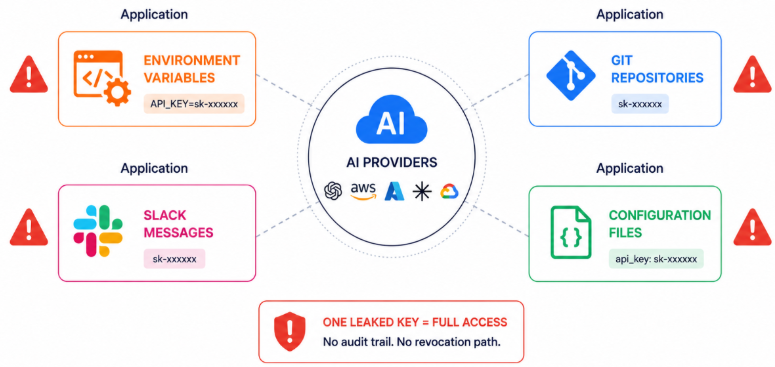
What is Upstream Authentication?
Upstream Authentication is a security capability in Envoy AI Gateway that automatically injects authentication credentials into requests before forwarding them to AI providers.
Instead of embedding credentials inside applications, the gateway retrieves them securely from Kubernetes Secrets and adds the appropriate authentication headers to every outbound request.
Applications simply send AI requests without any provider credentials.
Envoy AI Gateway handles the rest.
This approach provides several benefits:
- Centralized credential management
- Improved security
- Simplified credential rotation
- Consistent authentication across providers
- Zero application code changes
By moving authentication responsibilities to the gateway, organizations reduce both security risks and operational complexity.
How Upstream Authentication Works
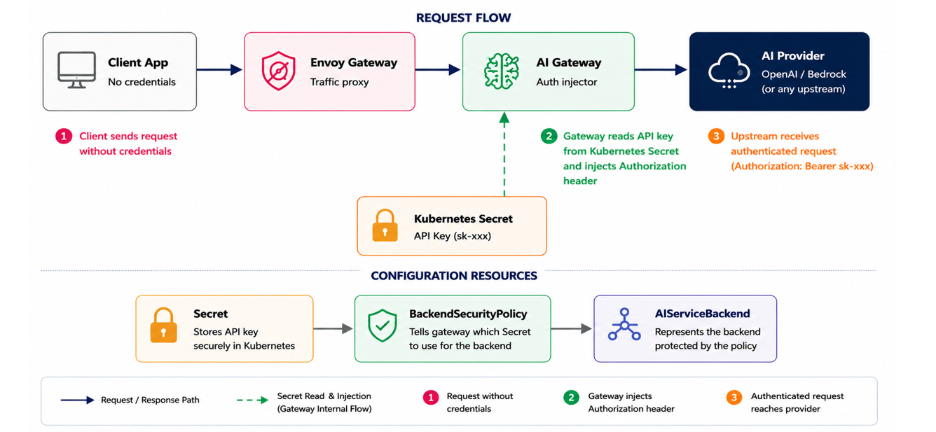
Upstream Authentication relies on three Kubernetes resources working together.
Step 1 – Store Credentials Securely
The API key is stored once inside a Kubernetes Secret.
Only the platform team manages the secret.
Applications never access it directly.
Step 2 – Configure BackendSecurityPolicy
A BackendSecurityPolicy references the Kubernetes Secret.
The policy tells Envoy AI Gateway:
- which backend should receive credentials
- what authentication method to use
- which secret contains the credential
Step 3 – Associate the Backend
The policy attaches to an AIServiceBackend.
Whenever traffic reaches that backend, Envoy AI Gateway automatically injects the required authentication header.
Step 4 – Forward the Request
The gateway sends the request to the AI provider with the appropriate credentials already included.
The application remains unaware that authentication occurred.
No SDK modifications.
No credential management inside the application code.
Architecture Overview
The Upstream Authentication architecture consists of three primary resources that work together to secure AI requests.
Kubernetes Secret
Stores provider credentials securely.
BackendSecurityPolicy
Defines how credentials should be retrieved and injected into upstream requests.
AIServiceBackend
Represents the protected AI provider that receives authenticated traffic.
When a client sends an AI request, Envoy AI Gateway retrieves the appropriate credential from the Kubernetes Secret, injects the required authentication header, and forwards the request to the configured backend.
The application never handles or even sees the provider credentials.
Configuration Walkthrough
The demonstration uses three Kubernetes resources.
Kubernetes Secret
Stores the provider API key securely.
The credential exists only once within the cluster.
BackendSecurityPolicy
Associates the Kubernetes Secret with a backend and defines the authentication mechanism.
The gateway automatically retrieves the credential whenever requests are routed to that backend.
AIServiceBackend
Defines the AI provider receiving traffic.
When requests reach this backend, authentication headers are injected automatically before forwarding.
Together, these three resources eliminate the need to distribute API keys across multiple applications while maintaining centralized security management.
Supported Authentication Types
Envoy AI Gateway supports multiple authentication mechanisms through a unified configuration model.
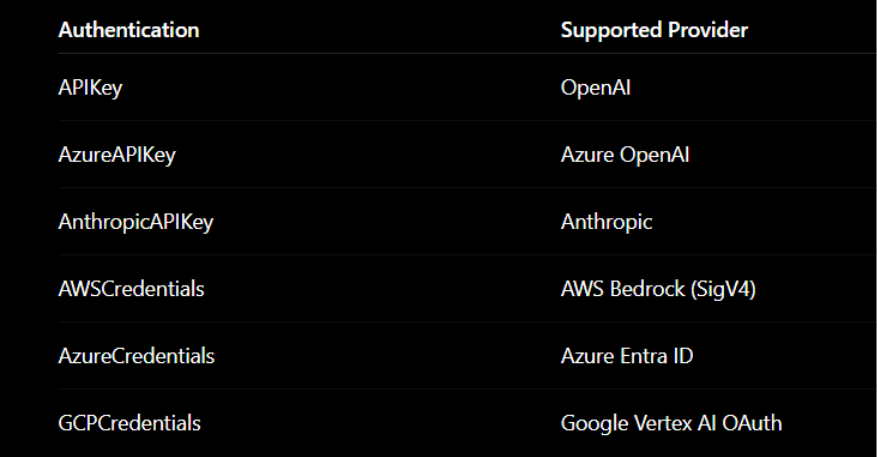
Some providers rely on static API keys, while cloud-native providers such as AWS, Azure, and Google support automatically rotated credentials using their respective identity services.
This unified approach enables organizations to standardize authentication across multiple AI providers while minimizing operational effort,
Sample Demo Results
The demonstration was deployed on an Azure Kubernetes Service (AKS) cluster using Envoy AI Gateway.
The application sends requests without any provider credentials.
During testing:
- The application includes only its business headers.
- Envoy AI Gateway automatically injects the Authorization header.
- The backend successfully authenticates the request.
- AI responses are returned normally.
The demonstration confirms:
- API keys never exist inside application code.
- Credentials remain securely stored in Kubernetes Secrets.
- Authorization headers are injected automatically.
- No SDK modifications or application changes are required.
Production Best Practices
As organizations scale AI deployments, authentication strategies should evolve beyond simply storing API keys.
Recommended practices include:
- Store credentials exclusively in Kubernetes Secrets.
- Use BackendSecurityPolicy for centralized credential injection.
- Rotate credentials regularly.
- Grant least privilege access to provider credentials.
- Audit secret access through Kubernetes RBAC.
- Use cloud-native identity services where supported.
- Avoid exposing credentials through environment variables or application configuration.
Following these practices helps improve security while simplifying operations.
Why Platform Teams Should Care
Upstream Authentication is more than a security feature—it establishes a centralized trust layer for AI infrastructure.
By managing authentication at the gateway, platform teams can:
- Eliminate hardcoded credentials.
- Simplify credential rotation.
- Improve compliance and auditing.
- Standardize authentication across AI providers.
- Reduce developer access to sensitive secrets.
- Enable secure multi-provider AI deployments.
As organizations continue expanding AI workloads, centralized authentication becomes an essential component of enterprise AI governance.
Final Thoughts
As enterprises integrate more AI providers into production environments, protecting provider’s credentials becomes just as important as securing application traffic. Upstream Authentication in Envoy AI Gateway centralizes credential management by securely storing secrets in Kubernetes and automatically injecting authentication headers at the gateway layer.
This approach eliminates hardcoded API keys, simplifies credential rotation, improves security, and enables organizations to adopt multiple AI providers without modifying application code.
At IMESH, we help organizations deploy, secure, and operate Envoy AI Gateway in production with enterprise-grade support, architecture guidance, troubleshooting, upgrades, and best-practice recommendations for building secure and scalable AI platforms